

Internet failures bleed money fast. Industry data shows small and mid-size firms lose $8 000–$25 000 every hour of unplanned downtime, so a full business day offline can burn roughly $150 000 in lost sales and productivity. (idc.com)
According to Techdirt, KUB’s municipal build – on track to become the largest community-owned network in U.S. history – has jolted incumbents like AT&T and Comcast into real price and service battles.
Most “best ISP” lists still lean on 2023 data and miss new entrants. We re-ran the numbers, scoring every business-grade provider on uptime, symmetry, cost, support, and scalability. The pages ahead keep jargon light and focus on one goal: helping you avoid those $150 000 headaches. Ready to see who tops the list? Read on.
How we built a ranking you can trust
We scored each provider with the same tough standards we use for our own offices. Downtime leads the list, but price clarity, real upload speed, and live human support all matter too.
To keep bias out, we put every factor on a 10-point scale, multiplied by its weight, and let the totals set the order.
Here is the formula:
- Reliability & uptime – 30 %
- Speed and symmetry – 25 %
- Cost vs. value – 20 %
- Support quality – 15 %
- Scalability extras – 10 %
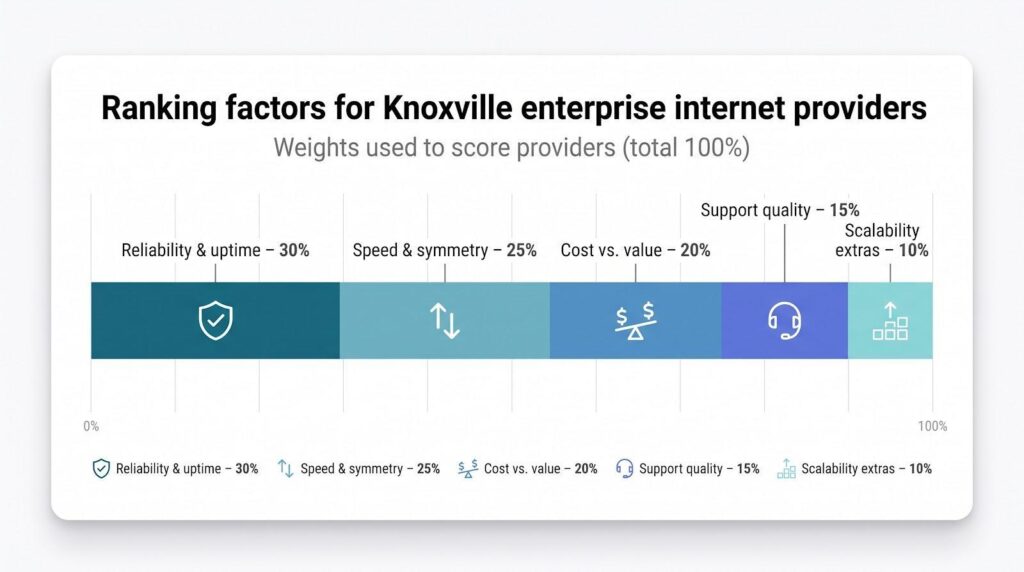
A 99.99 percent SLA protects far more revenue than a flash sale that fails when the cable is cut. Yet no Knoxville firm should pay for unused capacity, which is why cost per megabit and contract flex still count.
Before the first speed test, we set strict inclusion rules. Each finalist must:
- Serve Knoxville businesses today
- Publish some SLA detail or business support hours
- Own or operate a fiber or hybrid network in the metro area
Providers on legacy DSL, or pure resellers with no local footprint, missed the list.
Use our framework, swap in your own weights, and build a shortlist that meets your risk and budget. The picks that follow rest on that same transparent process.
1. WOW! Business – best for budget-conscious enterprises
Think of WOW! as the scrappy regional contender that punches above its weight. It inherited Knoxville’s old Knology cable plant, upgraded it, and now sells gig-speed service for less than some competitors charge for 300 Mbps.
Most businesses start with the 600 Mbps or 1.2 Gbps coax tier. Downloads move fast, day-to-day latency stays in the teens, and, important for designers or cloud backup, there is no data cap waiting to throttle heavy users.
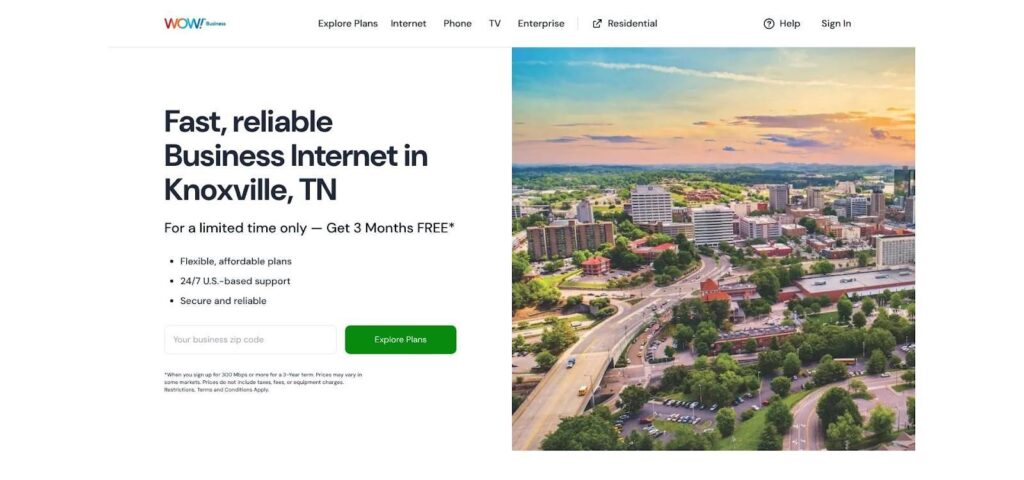
Upload speed is the only clear compromise. Coax tops out around 50 Mbps upstream, so if you push large files all day you will notice the ceiling. Need symmetry? Ask sales about WOW!’s fiber dedicated internet. It scales to 10 Gbps and carries a 99.99 percent uptime target, though pricing shifts from “bargain” to “enterprise” once you cross that line.
Value is where WOW! stands out. Promotional pricing drops a full gigabit connection into the seventy-dollar range on a short contract, and the online rate card lists a 60-day satisfaction guarantee plus a rate lock on select tiers, as detailed on the Knoxville, TN business internet services page. Even after the promo window, cost per megabit still beats most cable and many fiber offers in town. Installation is quick because the network is already on the poles outside your office, and local techs handle turn-ups without layers of dispatch red tape.
Customer sentiment is equally wallet-friendly. Users on Knoxville IT forums praise support reps who pick up the phone and field crews that show up on time. Issues do occur, especially after a big storm, but restore times are generally measured in hours, not days, and the 24 / 7 business line routes you straight to a human.
Who should choose WOW!? Small and mid-size teams that need fast, low-cost, reliable downloads and can live with slower uploads. It is also a smart secondary circuit: pair affordable WOW! coax with a fiber primary and you gain cost-effective redundancy without paying duplicate premium rates.
Bottom line: if your priority is keeping monthly spend low while avoiding the hefty price tag of a true fiber DIA, WOW! Business belongs at the top of your quote list. You will give up some upstream horsepower, but you will hold onto far more cash for the next line item in your IT budget.
2. AT&T Business: best overall reliability and fiber reach
When uptime tops your risk register, AT&T is the easy call. Its fiber network covers roughly half of Knoxville, delivers symmetrical gigabit to most commercial districts, and backs that speed with the city’s most mature SLA.
Standard Business Fiber promises 99.9 percent availability. Step up to Dedicated Internet and the guarantee tightens to 99.99 percent with a four-hour repair clock. Those numbers mean minutes of potential downtime per month, not hours, which protects revenue.
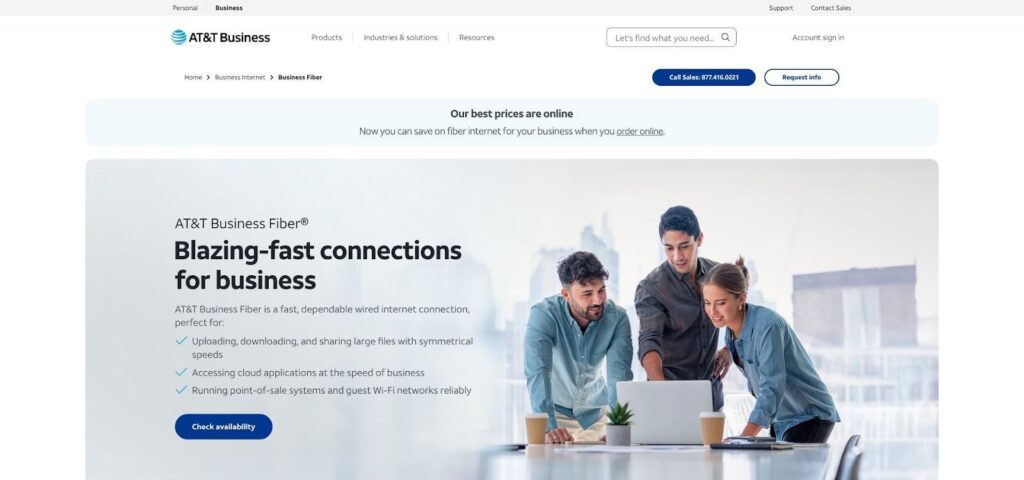
GPON fiber now peaks at 5 Gbps both ways, plenty for real-time collaboration, large cloud backups, or telemedicine that must not stutter. If you outgrow that, AT&T will light a private 10-Gbps circuit and reserve bandwidth to the backbone.
Pricing sits above coax bargains but remains predictable. AT&T often sells gigabit for just over a hundred dollars on month-to-month terms, skipping the three-year handcuffs of old. No data caps, no throttling, and price-lock promos up to two years steady the bill. Add the wireline-plus-5G failover bundle for automatic continuity at a small premium.
Support seals the deal. Business customers bypass the residential queue and reach a U.S.-based NOC that can push config changes or dispatch a technician overnight. Larger accounts also get a named rep who guides installs at new branch offices, a plus when you scale statewide.
Who should pick AT&T? Any organization that treats connectivity as mission-critical, not a utility. Law firms filing briefs minutes before deadline, clinics streaming high-def imaging, or SaaS teams pushing code to cloud repos all gain from the solid backbone and deep service catalog. Choose AT&T if you will pay a modest premium to keep the outage counter near zero.
3. Comcast Business: best for city-wide availability and easy scaling
Comcast is the provider you can order almost anywhere with one ZIP code check. Its hybrid fiber-coax plant covers about ninety-five percent of Knoxville addresses, so if you move suites, add a warehouse, or open a storefront across town, service is usually one call away.
Baseline cable plans reach 1.25 Gbps downstream and 35 Mbps up. That asymmetry is the price of near-universal reach, yet for point-of-sale traffic, video meetings, or large software downloads, the downstream muscle keeps teams productive.
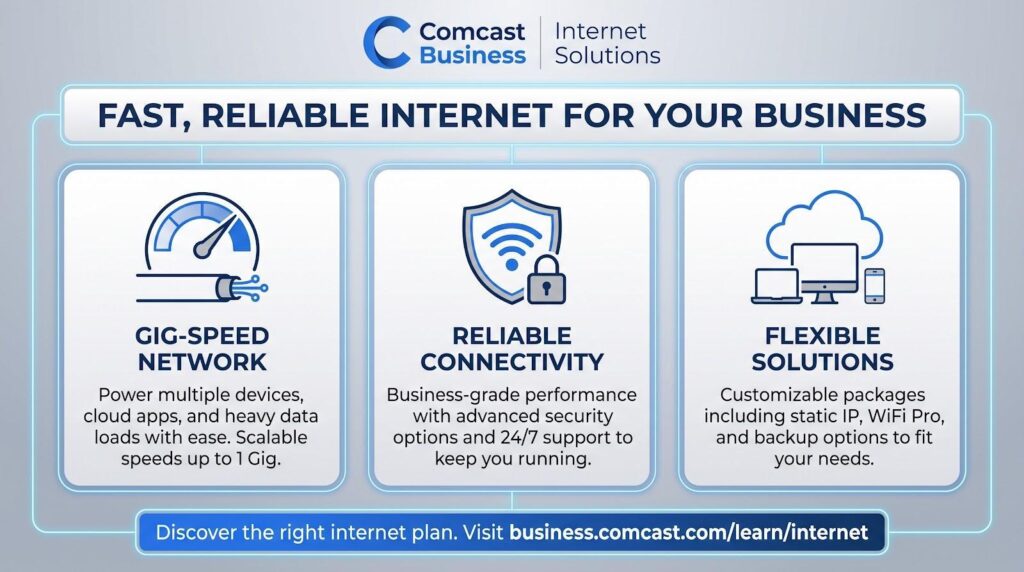
Need more headroom or a tighter SLA? Comcast can switch you to a fiber Ethernet circuit that scales from 100 Mbps to 10 Gbps with a 99.99 percent guarantee. The upgrade costs more, but the same account team and billing portal follow you, making growth simple.
Pricing sits mid-pack. Expect about seventy dollars for a 50 Mbps starter tier and roughly three-fifty for coax gigabit on a two-year price lock. Predictability is the perk: contracts often freeze your rate for the full term, shielding you from surprise hikes.
Reliability on coax depends on neighborhood load, yet Comcast eases the risk with its Connection Pro LTE failover box. If a backhoe cuts the line, the router flips to cellular in under a minute, keeping card readers, VoIP calls, and cloud apps alive until repairs finish.
Support has improved. Business customers bypass the residential IVR maze and reach reps who understand static IPs, VLAN tags, and SLA credits. Field dispatch is usually same day for critical outages, and the online portal shows real-time modem stats that help you diagnose issues before calling.
Comcast fits firms that prize footprint and flexibility over perfect symmetry. Think regional retailers opening new locations, construction crews with job trailers that move each quarter, or offices outside the current fiber footprints of AT&T or KUB.
Choose Comcast when you need an internet workhorse that follows you wherever your Knoxville expansion leads, with the option to upgrade to full fiber the moment workloads demand it.
4. KUB Fiber: best for local support and symmetric gigabit
KUB is Knoxville’s own utility, so when it strung fiber alongside power lines it changed the city’s connectivity playbook. Today that glass reaches nearly half of all business addresses, with crews lighting more blocks each quarter.
The network is pure fiber. The 500 Mbps and 1 Gbps plans move data at the same speed in both directions, a benefit cable uploads cannot match. Design shops, architects, and any team that pushes big files to the cloud notice the difference on day one.
Pricing keeps the hometown feel. Business Connect 500 starts at eighty-five dollars a month, billed month to month like a utility. No contracts, no teaser rates that spike later, and standard install is free while the build-out continues.
Reliability matches the pitch. Because the same fiber powers KUB’s smart-grid sensors, crews treat an internet outage like a utility emergency; they roll trucks quickly and fix issues at the source. Local IT admins report near-zero downtime, and when questions arise they reach a Knoxville-based support desk in seconds.
What KUB lacks in enterprise add-ons it makes up in community focus. You will not yet find managed SD-WAN or direct cloud on-ramps, but you do get static IPs, optional voice, and a provider whose profits flow back into city infrastructure. If supporting local matters to your brand, that’s a bonus.
Choose KUB Fiber when you want symmetric gigabit, transparent pricing, and people who live where you do answering the phone. First confirm your address is lit, or check the rollout map for an ETA. Then show incumbents that a public utility can match private-sector standards.
5. TDS Telecom: best for suburban coverage and value bundles
TDS is a quiet contender serving Knoxville’s western edges, such as Farragut, Hardin Valley, and other pockets where big brands never trenched fiber. If your office sits there, TDS may be the only provider that can deliver true gig-speed uploads without a custom build.
The company upgraded its legacy copper to XGS-PON, so fiber tiers now reach eight gigabits symmetrical. Most businesses will not need that headroom, but it shows the plant can grow as your data footprint expands.
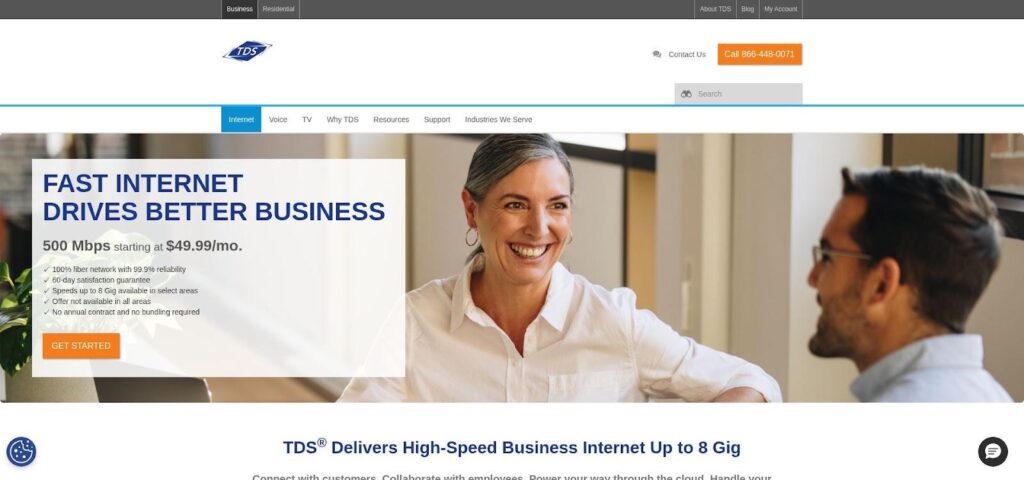
Pricing stays small-business friendly. A 100-Mbps fiber plan often starts below forty dollars, and 1 Gbps lands around ninety on a two-year agreement. Bundle internet with TDS hosted VoIP and you trim a few more dollars while ditching the dusty PBX.
Support keeps the local feel alive. Regional technicians handle installs, and the 24 / 7 business line sends you to reps who know Knoxville’s back roads and fiber routes. Outages are rare, but when a construction crew cuts a line, customers report prompt status texts and realistic repair ETAs.
Trade-offs exist. TDS coverage is patchy; if you are downtown, you will look elsewhere. And while the product set covers the basics, such as static IPs, voice, and simple security, it lacks enterprise cloud interconnects or managed SD-WAN.
Choose TDS when your address falls inside its suburban fiber footprint and you need high speeds, hometown service, and a phone-and-internet bill that keeps finance smiling.
Conclusion
Knoxville businesses no longer choose between price and uptime. WOW! Business keeps monthly spend low, AT&T Business leads on reliability and fiber reach, and Comcast follows you across nearly every address. KUB Fiber delivers hometown symmetric gigabit, while TDS covers the suburban edges the big builders skipped. Weigh downtime risk against budget, confirm the network at your exact address, and pick the provider that keeps those $150,000 outage days off your books.